


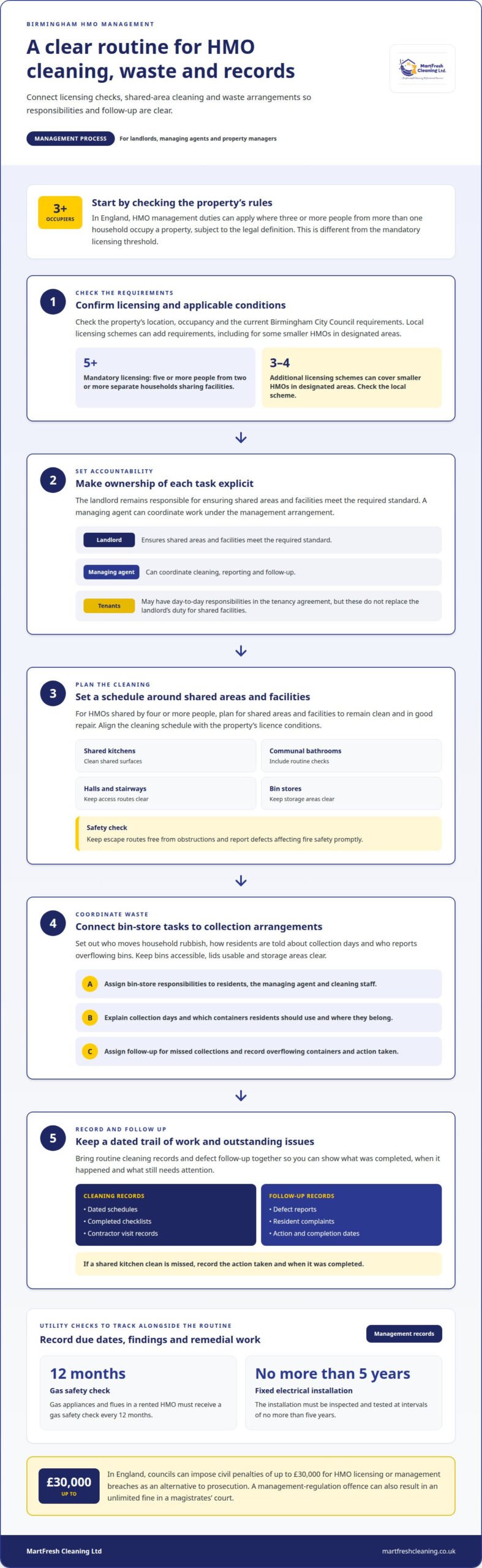
In England, HMO management duties can apply where three or more people from more than one household occupy a property, subject to the legal definition. This differs from the five-person mandatory licensing threshold.
These HMO cleaning regulations in the UK in 2026 make cleaning and waste arrangements part of property management, not an optional extra.
This guide explains how shared-area cleaning, waste and utilities fit into HMO management, and how Birmingham’s local licensing requirements and clear cleaning records can help you prepare for inspections.
Key Takeaways
- Separate your legal responsibility for common parts from the cleaning tasks and frequencies set out in your property’s management arrangements.
- For HMOs shared by four or more people, plan for shared areas and facilities to remain clean and in good repair, with enough rubbish bins.
- Review local licensing requirements and licence conditions, as council rules can shape the standards expected at your property.
- Keep utilities, waste arrangements and cleaning responsibilities clear so routine management supports inspection readiness.
Management duties for common parts and utilities in Birmingham HMOs
In England, the Management of Houses in Multiple Occupation (England) Regulations 2006 is a statutory instrument numbered 372, according to The National Archives. It provides the management framework for houses in multiple occupation. A landlord can appoint an HMO manager, but clear responsibility for common parts and essential services still matters. If you manage a Birmingham property, put reporting, repairs and routine checks into its management arrangements, and check the applicable Birmingham City Council requirements.
Common parts include shared halls, stairways and facilities. The Regulatory Reform (Fire Safety) Order 2005 sets duties for the common areas of HMOs and blocks of flats in England, according to The National Archives. Keep escape routes free from obstructions and report defects affecting fire safety promptly. A damaged communal door or blocked stairwell in a Birmingham property needs a recorded response, not just a note for the next visit.
Utilities need defined checks and records. The Health and Safety Executive says gas appliances and flues in a rented HMO must receive a gas safety check every 12 months. The fixed electrical installation must be inspected and tested at intervals of no more than five years. Record due dates, completed checks and outstanding remedial work so you can track each service.
Room sizes and licensing also shape management. According to the UK Government, the minimum bedroom size for a single room in an HMO is 6.51m². Mandatory licensing applies when five or more people from two or more separate households share facilities. Local licensing schemes can add requirements, so check Birmingham City Council’s selective or additional licensing requirements for the property.
Breaches can carry serious consequences. In England, councils can impose civil penalties of up to £30,000 for HMO licensing or management breaches as an alternative to prosecution. A management-regulation offence can also result in an unlimited fine in a magistrates’ court. Birmingham City Council may prosecute, so record issues, actions and completion dates.
- Assign responsibility for repairs, utility checks and contractor access.
- Log gas and electrical inspection dates, findings and follow-up work.
- Record shared-area defects, including their location and resolution.
Landlord responsibilities for shared-area cleanliness
Shared kitchens, bathrooms, halls and bin stores need clear cleaning arrangements. Landlords should keep shared areas and facilities clean and in good repair.
Cleaning rules across the UK nations
HMO cleaning duties and licensing rules vary across the UK. Do not assume that England’s rules apply unchanged in Scotland, Wales or Northern Ireland. First identify the local housing authority and the licensing scheme that covers the property. Its requirements may affect shared-accommodation standards and how compliance is assessed.
Licence conditions and cleaning requirements
An HMO licence sets conditions for the property and its management, which may cover shared-area cleanliness and repair. In England, the landlord’s duty applies when 4 or more people share the home, regardless of whether a cleaning contractor is appointed. Keep the cleaning schedule aligned with the licence conditions, and include practical tasks such as cleaning shared kitchen surfaces, checking communal bathrooms and keeping access routes clear.
Cleaning records for inspections
Inspection records should show what was cleaned, when the work was completed and which issues needed follow-up. Keep dated schedules, completed checklists, contractor visit records, defect reports and resident complaints together. For example, if a shared kitchen clean is missed, record the action taken and when it was completed. This gives you a clear account of routine work and outstanding concerns.
Cleaning roles in an HMO
The landlord is responsible for ensuring shared areas meet the required standard; a managing agent can coordinate the work under the management arrangement. Tenants may have day-to-day responsibilities set out in their tenancy agreement, but this does not replace the landlord’s duty for shared facilities. Define who reports problems, who arranges cleaning and who follows up. A written HMO communal cleaning schedule can make those responsibilities easier to manage.
What HMO cleaning and waste-management requirements do local councils impose?
Local council requirements depend on the property’s location, licensing scheme and applicable HMO conditions. In Birmingham, check the requirements that apply to the property and its location, as schemes and conditions can vary. Waste arrangements should work alongside cleaning routines, so rubbish is stored and removed without obstructing shared areas.
In England, mandatory HMO licensing applies when five or more people from two or more separate households share facilities. Additional licensing schemes can cover smaller HMOs, often those with three or four occupiers in designated areas. Check Birmingham City Council’s current requirements for the property, as a local scheme may add management requirements even when a property falls below the mandatory licensing threshold.
Set a clear waste routine: specify who moves household rubbish to the bin store, how residents are told about collection days and who reports overflowing bins. If a collection is missed, assign someone to follow it up and record the issue. Keep bins accessible, lids usable and storage areas clear to prevent waste spilling into entrance halls or escape routes.
- Identify the applicable Birmingham licensing scheme and any property-specific conditions.
- Set out bin-store responsibilities for residents, the managing agent and cleaning staff.
- Record missed collections, overflowing containers and the action taken.
HMO landlords in Birmingham should arrange for waste to be managed properly. A practical routine links council collections with resident communication and regular bin-store checks. Explain which containers residents should use and where they belong. Include checks of floors and accessible surfaces in the cleaning schedule, and direct collection or disposal problems to the responsible manager.
For property managers, waste controls need to work in practice, not just appear in a written plan. Review the routine when occupancy or collection arrangements change, or when complaints recur. If Birmingham City Council raises a concern during a visit, record the issue, assign corrective action and note when it is completed. This creates a traceable response while keeping routine communal cleaning distinct from specialist waste removal.
What cleaning requirements do HMO licence conditions typically include?
HMO licence conditions set property-specific standards alongside landlords’ general management duties. In England, licensed HMOs must meet conditions covering fire safety, minimum room sizes and amenities. Cleaning supports these standards by keeping shared facilities usable and helping managers identify defects before they worsen.
Conditions may cover the upkeep of shared kitchens, bathrooms, corridors and other common areas. Exact requirements depend on the council and licensing scheme, so check the relevant Birmingham City Council licence conditions for the property. A cleaning specification can turn these expectations into assigned tasks, such as cleaning food-preparation surfaces, removing visible waste and reporting leaks or damaged fittings. Keep routine cleaning separate from repairs, which need their own follow-up.
Room standards can also affect licence management. Councils may set bedroom-size standards above the stated minimums. A cleaning plan cannot resolve an undersized room, but a documented inspection can flag issues such as mould, leaks or damage that need attention. Record these separately from routine cleaning tasks.
- Record the areas covered, agreed tasks and cleaning frequency.
- Note defects or hazards found during cleaning and assign follow-up.
- Track completed actions against the relevant licence condition.
Take particular care with shared routes and facilities. A cleaning checklist can include checking that corridors and stairwells are clear, but cleaners are not responsible for maintaining fire systems. Report an obstructed exit or damaged safety feature promptly to the property manager, and record the action taken.
Use the council’s licence conditions as the property-specific reference, then align the cleaning schedule with them. A clear scope helps residents, agents and cleaning staff understand who does what. For a defined HMO communal cleaning scope, arrange a cleaning assessment.
MartFresh Cleaning Ltd
MartFresh Cleaning Ltd helps landlords and property managers in Birmingham and the wider West Midlands maintain consistent HMO communal-area standards through agreed cleaning scopes and schedules. Its Block & Communal Area Cleaning can cover entrance halls, corridors, staircases, shared facilities and bin stores, with tasks set out in a cleaning specification and checklist.
For managed properties, a defined scope provides a record of agreed work and a practical way to report cleaning issues or maintenance concerns. Site assessments and photo reporting can be included where required, helping property teams track tasks. Cleaning supports day-to-day management but does not replace licensing, fire-safety or repair duties.
This support can help when recurring visits, resident feedback or inspection preparation make informal arrangements difficult to manage. Contact MartFresh Cleaning Ltd to discuss your HMO cleaning requirements.
Build a consistent approach for your HMO
Use the HMO cleaning regulations UK 2026 as a prompt to review how cleaning fits your property’s wider management process. A written scope can help your team identify where contractor responsibilities end and where maintenance or licensing actions need separate attention. Revisit the arrangement when the property’s use or management needs change.
MartFresh Cleaning Ltd also supports property teams with After-Builders & Post-Construction Cleaning and End-of-Tenancy Cleaning. These services can help prepare a property after refurbishment or between occupancies, keeping cleaning needs distinct from ongoing compliance duties.
If you’re planning a cleaning schedule or preparing a property for its next stage, contact MartFresh Cleaning Ltd to discuss the site requirements.
Frequently Asked Questions
What changed for HMOs in 2026?
The HMO cleaning regulations UK 2026 framework continues to rely on existing management regulations and applicable local licence conditions. The Management of Houses in Multiple Occupation (England) Regulations 2006 remains the framework for management duties in England. In Birmingham, check the council’s HMO licensing scheme and the conditions that apply to the property, as these may set additional requirements. No single national cleaning frequency applies to every HMO.
What housing standards apply to HMOs?
HMO standards cover a property’s condition, facilities, fire safety and suitability for occupation. Councils use the Housing Health and Safety Rating System to assess hazards, and licence conditions can cover amenities and room sizes. For example, a local authority may require action on a hazard affecting the safe use of a kitchen or bathroom. Check the relevant Birmingham council scheme for any local bedroom-size standards, which may exceed the stated minimums.
What is a house in multiple occupation (HMO)?
An HMO is generally a house or flat occupied by people from more than one household who share facilities, such as a kitchen or bathroom. In England, the UK Government says mandatory licensing applies when five or more people from two or more separate households share facilities. A property’s exact status depends on how it is occupied and the relevant legal definitions. In Birmingham, check with the council whether the property also falls under an additional licensing scheme.
What is the difference between an HMO and a large HMO?
“Large HMO” commonly refers to a property occupied by five or more people from two or more households who share facilities, meeting England’s mandatory licensing threshold. Smaller HMOs may still need a licence under a council’s additional licensing scheme. In Birmingham, check the council’s scheme for the property’s location. This distinction affects licensing, not the responsibility to manage shared facilities.
What cleaning standards apply to HMOs in England in 2026?
Shared areas and facilities should be kept clean and in good repair in an HMO. Licence conditions may add property-specific expectations. In Birmingham, check the relevant council scheme and licence conditions when setting a cleaning schedule for kitchens, bathrooms, corridors and bin stores, while distinguishing cleaning from repairs. For instance, a cleaner can report a leaking tap, but the repair needs separate follow-up.
What are landlords’ legal responsibilities for cleaning and maintaining HMO communal areas?
The landlord remains responsible for meeting an HMO’s legal management duties, even if a managing agent coordinates day-to-day work. Agreed tenant responsibilities do not replace the landlord’s obligations for communal facilities. Specify who arranges cleaning, responds to reports and deals with repairs, taking account of any relevant Birmingham council scheme and licence conditions. Record issues and actions so responsibilities remain clear if concerns arise.