


Is commercial cleaning just a “nice to have”, or does it directly affect cost and risk in your building?
It directly affects cost and risk.
Poor cleaning increases slip risk, raises complaint volume, accelerates wear on floors and shared areas, and contributes to avoidable sickness disruption. UK data backs this up.
WHY THIS MATTERS NOW
UK workplace sickness is not a small problem.
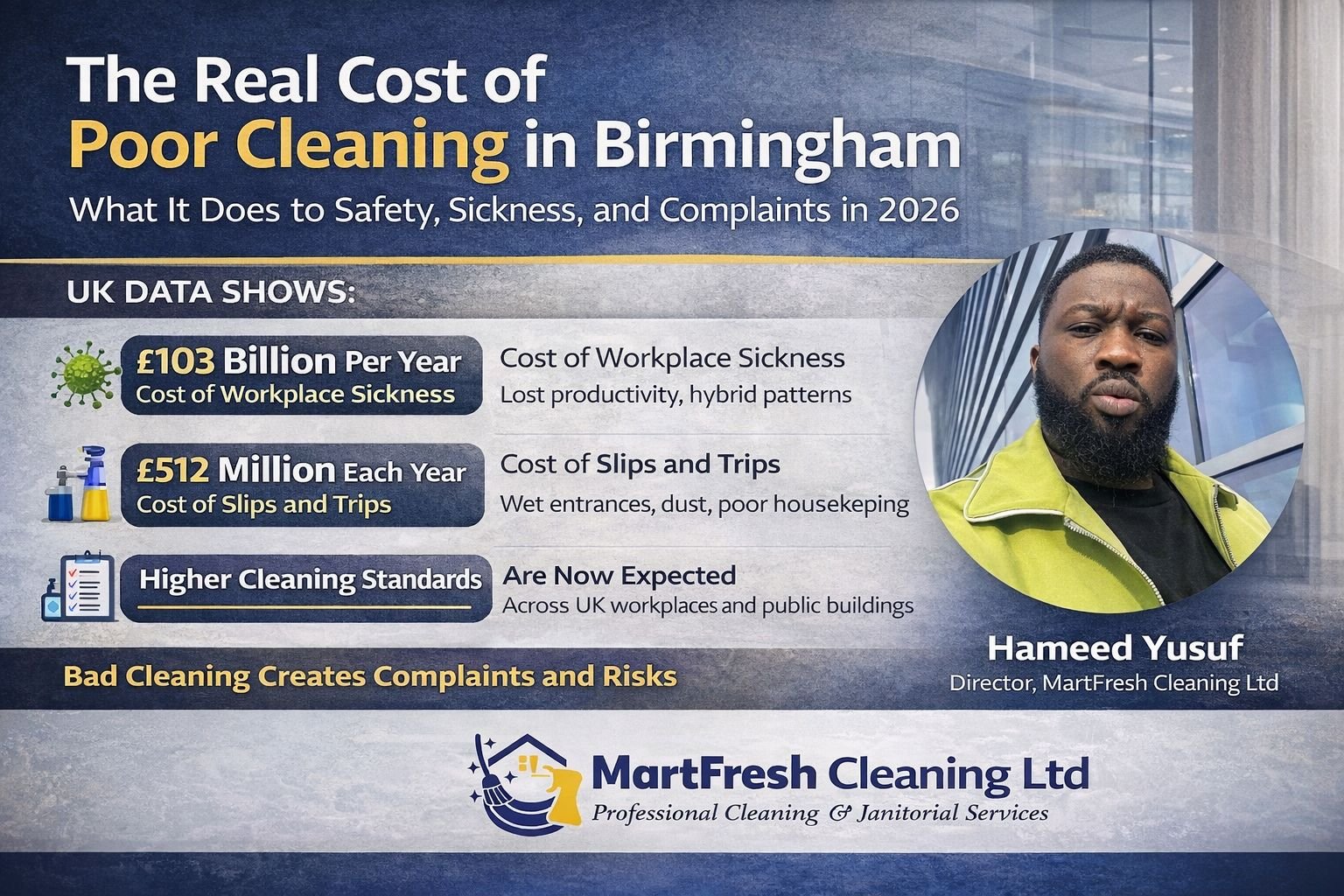
A major UK report estimated the cost of workplace sickness at £103 billion in 2023, driven heavily by lost productivity and people working while unwell.
Slips and trips are also not minor.
HSE estimates slips and trips cost UK employers around £512 million per year in lost production and other costs, and highlights contamination like water and dust as common causes. 
Now add how buildings are used in 2026.
More than a quarter of working adults in Great Britain were hybrid working in autumn 2024, which changes occupancy patterns, shared touchpoints, and peak day pressure. 
So cleaning has moved from “out of hours housekeeping” to operational control.
WHAT THIS LOOKS LIKE IN BIRMINGHAM
Birmingham is not one environment.
- Birmingham city centre and the Jewellery Quarter
– Higher footfall, tighter access windows, more high-touch points.
- Digbeth
– More tracked debris and surface marking, faster entrance deterioration.
- Moseley
– Higher expectation on finish, more complaint sensitivity.
- Erdington and Washwood Heath
– More shared living, communal washrooms and kitchens drive most issues.
- Solihull and Sutton Coldfield
– Larger floor plans, more surface area, higher time requirement.
If your contractor runs the same routine everywhere, standards drift and costs rise.
WHAT ARE THE BIGGEST RISKS OF POOR COMMERCIAL CLEANING
Most issues fall into three buckets.
1. Safety risk
Wet entrances, grit, and poor housekeeping increase slip and trip likelihood. HSE repeatedly flags contamination as a major factor in slips.
2. Sickness disruption
When high-touch points and shared washrooms are not controlled, illness spreads faster through shared spaces. This matters more when hybrid patterns concentrate attendance into peak days.
3. Reputation and complaints
Complaints almost always begin in washrooms, kitchens, lifts, stairwells, and entrances. If these drift, tenants and staff assume everything else is also unmanaged.
WHAT “HIGHER STANDARDS” MEANS IN 2026
Industry bodies are pushing the same message. The British Cleaning Council has published a structured framework aimed at achieving cleanliness and hygiene in public environments, focused on defining standards, assessing risk, implementing procedures, and measuring outcomes over time.
That direction matters for managed buildings and workplaces because it reinforces one point.
Cleaning must be planned and measured, not guessed.
WHAT SHOULD A COMMERCIAL CLEANING SCOPE INCLUDE?
A scope should be written to match how the building is used. At minimum it should define:
Zones and frequencies by area
– Entrance and reception, floors, stairs, lifts, washrooms, kitchens, offices, bins.
High-touch point list and frequency
– Handles, switches, rails, lift buttons, keypads, shared equipment points.
Method and products by environment
– What is used in washrooms, kitchens, general areas, and why.
Periodic tasks
– Weekly detail, monthly machine work, quarterly deep cleans.
Quality checks and proof
– Checklists, spot checks, issue reporting, escalation.
If your contractor cannot document this clearly, the standard will vary by cleaner.
WHY DO CLEANING CONTRACTS FAIL AFTER 60 TO 90 DAYS?
This is the most common pattern we see when a site changes cleaners.
Week 1 to 2
– The site looks improved because effort is high and the contractor is trying to impress.
Week 3 to 6
– Scope gaps show up. Washrooms start slipping. Touchpoints get skipped. Floors lose finish at entrances.
Week 6 to 12
– Complaints rise, re-cleans begin, and the managing agent or FM team starts chasing.
That pattern is almost always caused by a missing system:
No scope control, no COSHH control, no measurable checks.
WHAT DOES COSHH CONTROL LOOK LIKE ON A CLEANING SITE
It should look like control, not paperwork.
Products are selected for the surface and risk, not what is cheapest.
Dilution is controlled, not guessed.
Bottles are labelled if decanted.
Products are separated, never mixed.
This matters because cleaning failures are often chemical failures.
Wrong dilution increases fumes and reduces effectiveness.
Wrong product combinations can create dangerous exposure risks.
THE BIRMINGHAM CONTROL MODEL
If you want commercial cleaning services Birmingham that stay consistent, the plan must prioritise what actually drives risk and complaints.
1. Entrances first
Because contamination enters here. Matting checks, spot mops, and daily edge detailing reduce slips and protect floors.
2. Washrooms and shared kitchens next
These drive most dissatisfaction and most hygiene complaints.
3. High-touch points every visit
This is where hygiene fails begin, especially on peak occupancy days.
4. Measurable checks
No checklist means no proof.
No proof means no control.
WHAT THIS MEANS FOR PROPERTY AND FACILITIES TEAMS
If you manage office cleaning Birmingham, HMO cleaning Birmingham, communal area cleaning Birmingham, facilities management cleaning Birmingham, or block management cleaning Birmingham, your goal is not a clean building at 9am.
Your goal is predictable standards all month.
The moment you stop treating cleaning like a controlled service, you start paying in:
Complaints, re-cleans, slip risk, and disruption.
HOW MARTFRESH RUNS IT
At MartFresh Cleaning Ltd, we run cleaning as a controlled operational service.
- – Clear scopes.
– High-touch routines.
– Correct chemical control and dilution.
– Quality checks that can be evidenced.
– Communication that flags issues early.
This is how we protect standards across Birmingham city centre, Digbeth, Jewellery Quarter, Moseley, Erdington, Washwood Heath, and Solihull.