

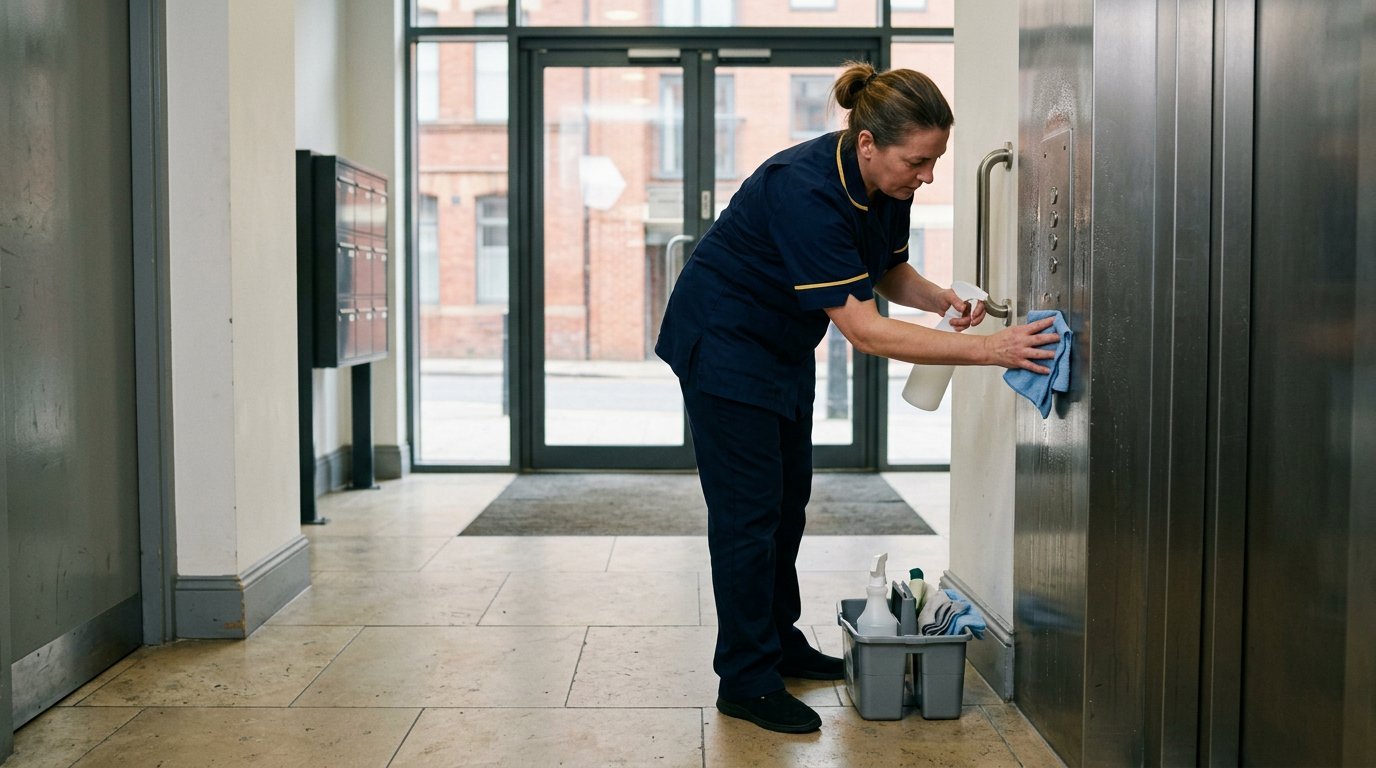

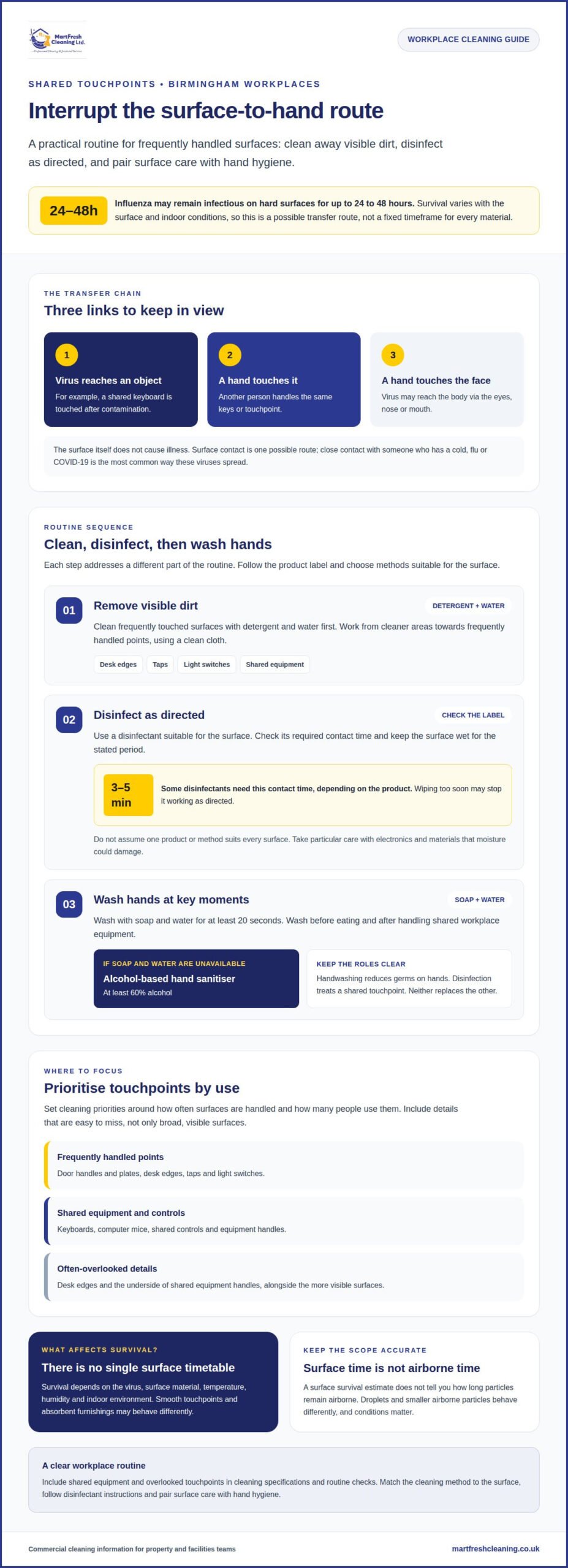
Influenza viruses may remain infectious on hard surfaces for up to 24 to 48 hours, although survival varies with the surface and indoor conditions. A shared desk or door handle can therefore remain a possible route of transfer after contamination.
For property and facilities teams, understanding how long flu germs live on surfaces puts routine cleaning into context. The time varies with the virus, surface material and surrounding conditions. This article explains which shared touchpoints to prioritise and how cleaning and hand hygiene fit into workplace routines in Birmingham.
Key Takeaways
- Set cleaning priorities around how often surfaces are handled and how many people use them.
- Follow the disinfectant label’s contact time, keeping the surface wet for the stated period.
- Handwashing with soap and water for at least 20 seconds helps reduce the risk of catching respiratory viruses.
- Include shared equipment and overlooked touchpoints in cleaning specifications and routine checks.
Cleaning and disinfecting frequently touched surfaces
In managed workplaces, remove visible dirt from frequently touched surfaces with detergent and water, then use a suitable disinfectant according to its label. Cleaning removes dirt, while disinfection targets germs on the surface.
Cleaning commonly touched surfaces
Commonly touched surfaces are items handled repeatedly by staff, visitors or contractors, such as desk edges, computer mice, taps and light switches. Their frequent use makes them practical priorities in a commercial cleaning specification.
Work from cleaner areas towards frequently handled points, using a clean cloth and suitable detergent. Include details such as desk edges and the underside of shared equipment handles, not just broad, visible surfaces. Materials and conditions affect how long germs survive, so choose a method appropriate for each item.
Disinfecting frequently touched surfaces
Disinfection uses a product intended to kill germs on a surface. It may be useful on frequently handled points, particularly during illness or when staff share equipment.
Check the product label for suitable surfaces and the required contact time. Some disinfectants need the surface to stay wet for three to five minutes, depending on the product. Wiping too soon may stop it working as directed. Do not assume one product or method suits every surface, especially electronics or materials that moisture could damage.
Combining handwashing with surface disinfection
Handwashing and surface disinfection address different points in the transfer chain. Washing reduces germs on hands; disinfecting treats a shared touchpoint.
Wash your hands with soap and water for at least 20 seconds to reduce the risk of catching viruses that cause colds, flu and COVID-19. Wash before eating and after handling shared workplace equipment. If soap and water are unavailable, use an alcohol-based hand sanitiser containing at least 60% alcohol. These steps complement routine commercial cleaning; neither replaces the other.
Do cold and flu viruses stay contagious outside of the body?
Yes. Cold and flu viruses can remain infectious outside the body, but survival time depends on the virus, surface material and surrounding conditions. A surface survival estimate does not tell you how long particles remain airborne.
Factors affecting virus survival
Survival depends on the virus’s structure, the surface it lands on, temperature, humidity and the indoor environment. This matters in shared offices, where smooth touchpoints and absorbent furnishings may both be present.
Cold viruses can remain on surfaces for up to one week, although their effectiveness falls after the first 24 hours. Infectious particles on hands are usually gone after 20 minutes, while cold germs can live on hands for up to one hour. These findings describe different measures and should not be treated as interchangeable.
Influenza survival on hard and soft surfaces
Influenza survival varies by material. A 2008 publication reported that influenza viruses remained infectious on banknotes for up to three days, showing that a surface’s everyday use does not immediately remove contamination.
That figure does not establish how long a virus survives on every hard surface. Metal, plastic, paper and fabric differ, and indoor conditions matter too. A finding about banknotes cannot be treated as a fixed timeframe for an office desk or another material.
Virus survival on porous materials and fabrics
Porous materials such as cloth and paper interact with deposited particles differently from smooth surfaces. Influenza viruses usually survive on soft materials for several hours, while rhinoviruses generally persist for less time on fabrics or tissues than on hard surfaces.
Flu germs on hands can remain infectious for up to one hour. Respiratory droplets and aerosols behave differently: droplets may settle on nearby objects, while smaller airborne particles move with indoor airflow. How long they remain infectious depends on particle size and environmental conditions, so surface survival times cannot estimate how long particles stay suspended in the air.
How cold and flu viruses spread via contaminated surfaces
Surface transmission follows a simple chain: virus reaches an object, transfers to a hand, then enters the body. A desk touched after someone coughs or sneezes nearby can become one link in that chain. Someone may touch a contaminated object minutes after exposure, then transfer virus from their hand to their eyes, nose or mouth.
For example, an infected person touches a shared keyboard, and a colleague later handles the same keys. If the colleague then touches their face without washing their hands, virus may reach the body. Door handles, desk edges and shared controls can create similar contact points. The surface itself does not cause illness; the relevant pathway is transfer from surface to hand and then to the face.
Close contact with someone who has a cold, flu or COVID-19 is the most common way these viruses spread. Surface contact is another possible route, rather than the only explanation for transmission in an office. Breathing near an infected colleague and handling an object they have just contaminated are different exposure situations. Both can happen during an ordinary working day.
Timing matters too. People with cold or flu infections can spread viruses before symptoms begin, so a colleague may not know they are infectious. A cough or sneeze can deposit virus on a nearby object that someone else touches minutes later. Shared touchpoints therefore matter in cleaning routines even when nobody appears unwell.
To interrupt this route, clean and disinfect regularly used touchpoints, then wash hands before eating or touching your face. A Birmingham office routine might cover desk surfaces, shared keyboards and door plates, as well as handwashing facilities. These measures address surface-to-hand transfer; limiting close contact with someone who is unwell addresses another route of spread. Neither changes how long a virus survives on a particular material.
Frequently touched surfaces that may harbour germs
In an office, prioritise surfaces handled by different people throughout the day. If you are asking, “how long do flu germs live on surfaces?”, the practical answer depends partly on the material and conditions. Cleaning plans should reflect the building’s actual touchpoints.
- At entrances, include door plates, access keypads and reception counters.
- In kitchens, include fridge handles, taps, kettle controls and shared counter edges.
- In meeting rooms, include chair arms, table edges, remote controls and presentation equipment.
- At shared equipment points, include printer panels, photocopier controls and switch plates.
Contact frequency helps distinguish priority areas from surfaces used by one person. A keypad handled by staff and visitors has a different use pattern from a private storage shelf. Facilities teams can record these differences in a site-specific cleaning checklist so tasks reflect how each office is used.
Flu can remain infectious on hard surfaces for up to 24 to 48 hours. That timeframe makes shared touchpoints relevant to cleaning schedules, particularly where people handle a surface before eating or touching their face. It does not mean every material carries the same risk for the same duration.
For a practical site review, follow an employee or visitor’s route through the building. Note the entrance, reception, lift, kitchen and meeting room, then list the surfaces people touch along the way. Include less obvious items, such as shared pens or water dispenser buttons, if they are handled regularly. The question “how long do flu germs live on surfaces?” should prompt you to consider contact frequency and material, not rely on one time estimate. A clear checklist helps cleaning teams cover these points consistently.
MartFresh
MartFresh Cleaning Ltd helps property and facilities teams maintain consistent cleaning standards in managed workplaces and buildings. Where desks, shared equipment and communal touchpoints are used throughout the day, a defined cleaning specification can clarify routine tasks and responsibilities.
MartFresh’s Office & Commercial Cleaning can be arranged around site requirements, cleaning frequency, operating hours and agreed specifications. Task checklists help set clear expectations and support quality control. Site inspections or photographic reporting can also form part of arrangements where required. This can help when an existing schedule does not consistently cover frequently handled surfaces, or when you need a structured plan for a Birmingham workplace.
Contact MartFresh Cleaning Ltd to discuss your site’s cleaning requirements and scope.
Turn surface risks into a clear site standard
Knowing how long flu germs live on surfaces is useful when it informs a practical cleaning specification. In your next review, identify who is responsible for each area, how completed tasks are recorded and when to reassess the schedule as site use changes. This gives property and facilities teams a clear basis for consistent delivery.
MartFresh Cleaning Ltd supports property professionals with Block & Communal Area Cleaning, After-Builders & Post-Construction Cleaning and End-of-Tenancy Cleaning. Agreed scopes and task checklists can be tailored to building requirements, helping you manage cleaning standards across offices, residential blocks and managed properties.
Set the next step by defining the areas and standards your site needs covered. Contact MartFresh Cleaning Ltd to discuss your requirements and establish a clear scope for your property.
Frequently Asked Questions
How long can germs remain on surfaces in managed properties?
Germs can persist from minutes to months, depending on the organism and conditions. There is no single answer for every setting. Temperature, humidity, surface material and the amount of contamination all affect survival. For example, Clostridium difficile can remain on hard surfaces for up to five months, much longer than many respiratory viruses.
How do germs spread in workplaces and communal areas?
Germs spread through close contact, respiratory particles and contaminated objects. Someone may transfer germs from their hands to an object, which another person then touches. Cold and flu viruses can also spread before symptoms appear, so transmission may occur before someone realises they are unwell. Handwashing before eating or touching your face helps interrupt transfer from hands.
How can cleaning reduce the spread of germs in managed properties?
No routine makes a managed property completely germ-proof, but you can reduce opportunities for germs to spread. Include frequently handled surfaces such as taps, cupboard handles and shared equipment in the cleaning specification. Use a suitable disinfectant as directed on its label, including the stated contact time. Handwashing before eating and avoiding touching your eyes, nose or mouth with unwashed hands can also help.
What kills germs on commercial surfaces?
Suitable disinfectants kill germs when used as directed on compatible surfaces. The World Health Organization states that temperatures of at least 140 degrees Fahrenheit (60 degrees Celsius) are enough to kill most viruses. Different germs and materials respond differently, so use the method appropriate to the surface and follow product directions. Cleaning first can remove visible dirt.
Why don’t cold and flu viruses live forever on workplace surfaces?
Cold and flu viruses need a host to reproduce; a desk or door handle cannot support that process. Outside the body, environmental conditions gradually damage infectious virus particles. Temperature, humidity and surface material affect how quickly this happens. As particles lose their ability to infect cells, the risk from that contamination falls, although survival times vary by virus and surface.
How long can influenza viruses survive on hard, non-porous surfaces?
Influenza may remain infectious on hard surfaces for up to 24 to 48 hours, depending on the conditions. A 2011 study found influenza viruses capable of infecting people were no longer present on most non-porous metal and plastic surfaces after nine hours. These findings describe different conditions, not a universal countdown for every desk.
[…] master schedule to preserve the building’s professional kerb appeal. For further guidance, see how long flu germs live on surfaces and how shared office touchpoints can contribute to their […]