


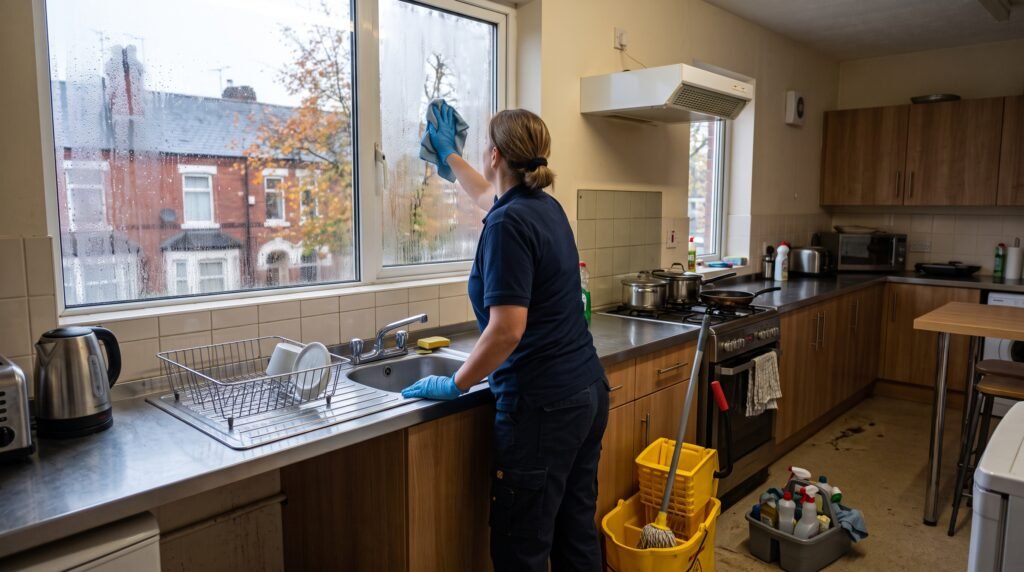
Heating goes on, windows stay shut, and shared kitchens and bathrooms fill with moisture. For Birmingham HMO landlords and property managers, autumn is when condensation starts turning into visible mould. And on 27 October, Awaab’s Law reaches its first anniversary in social housing, which has put damp and mould firmly back in the headlines.
Here is where the law stands for private HMO landlords, what you are already required to do, and a practical checklist for the months ahead.
Key Takeaways
- Awaab’s Law applies to social landlords in England only. It does not yet apply to private landlords.
- The Renters’ Rights Act 2025 gives the government the power to extend it to private tenancies, but at the time of writing we found no confirmed start date.
- Private landlords are not waiting on a start date. Existing law already requires homes to be free of serious damp and mould.
- Wiping away visible mould does not fix damp. The cause has to be found and dealt with.
- Dated photos, inspection notes and follow-up checks are your best evidence that you acted.
Does Awaab’s Law Apply to Private HMO Landlords?
Not yet. Awaab’s Law has applied to social landlords in England since 27 October 2025. It sets fixed deadlines to investigate and fix significant damp and mould hazards, and all emergency hazards.
The Renters’ Rights Act 2025 contains a power to extend the same approach to private rented homes. That extension needs a consultation and separate regulations first. The government’s implementation roadmap places it in the third phase of the Act, and some legal commentators expect 2027 at the earliest. Check GOV.UK for the latest position before you rely on any date.
The sensible reading is that the direction of travel is clear, even if the timetable is not.
The Rules That Already Apply to Your HMO
You do not need Awaab’s Law for damp and mould to be a legal problem today. Government guidance for landlords points to several existing duties:
- Housing Act 2004. Homes must be free of the most serious hazards, assessed under the Housing Health and Safety Rating System. Mould and all types of dampness are included.
- Environmental Protection Act 1990. Conditions that are prejudicial to health can be a statutory nuisance, which councils can act on.
- Homes (Fitness for Human Habitation) Act 2018. Rented homes must be fit to live in, and tenants can take court action if they are not.
Councils enforce these in the private rented sector. Tenants can also ask the local authority for an inspection.
Why HMOs Are Exposed
Shared houses put a lot of moisture into the air. Several people cooking, showering and drying laundry means more condensation, and condensation is the most common cause of damp in homes. GOV.UK guidance also notes that overcrowding can drive high humidity, and it lists people who live in HMOs, and private tenants who fear eviction, among those who may face barriers to reporting damp and mould.
That last point matters for property managers. In a house with five or six sharers, everyone can assume someone else has already reported it. Regular visits are how you find problems early.
What Cleaning Can and Cannot Do
Cleaning is part of the answer. It is not the whole answer. The government guidance is clear on the limits:
- Mould on hard surfaces can be removed with an appropriate mould and mildew cleaner, and left to dry fully. The guidance prefers these products to bleach for health and safety reasons.
- Photograph and document the affected area before removing mould, because it helps trace the source.
- Larger areas of mould should only be dealt with by qualified professionals. Absorbent materials such as carpets, soft furnishings and ceiling tiles may have to be thrown away.
- Whoever removes mould should wear a mask, gloves and goggles.
- Removing surface mould alone will not stop it coming back. The underlying cause, whether a leak, poor ventilation or a heating problem, has to be identified and fixed.
The guidance also says landlords should not wait for medical evidence before acting, and that tenants should not be blamed for damp and mould as a lifestyle issue.
A Winter Checklist for Birmingham HMO Landlords
Use this as a starting point for your autumn property visits.
- Walk the communal areas. Look at kitchen and bathroom ceilings, window frames, corners behind furniture and the lower parts of external walls for mould, staining, peeling paint or a musty smell.
- Check the extractor fans. Confirm kitchen and bathroom fans run. Servicing and replacement should be done by qualified professionals, and installing ventilation counts as controlled building work under the Building Regulations.
- Check windows and trickle vents. Make sure windows open and vents are not blocked.
- Confirm heating works. Cold homes are more prone to condensation, and tenants who cannot afford to heat may leave it off.
- Make reporting easy. Give every tenant a single, clear way to report damp and mould, in a form they will actually use.
- Photograph before you clean. Date-stamp the problem area, then treat small hard-surface patches with an appropriate mould and mildew cleaner.
- Escalate anything larger. Bring in a qualified damp surveyor or specialist for larger areas, recurring mould or any unexplained damp.
- Book the follow-up. Government guidance recommends revisiting at least six weeks after remedial work to confirm the problem has not returned.
- Keep records. Note what was reported, when you responded, what was done and what you found at follow-up.
Between Tenancies: The Best Time to Catch It
Guidance for landlords recommends checking for damp and mould between tenancies, including that ventilation and heating are working, and dealing with any cause before the room is re-let. A room that has just been emptied is the easiest time to spot mould behind furniture or on the back of a wardrobe. It is also the point where a proper turnover clean and inspection can be combined in one visit.
If you are preparing rooms for new sharers, our end of tenancy and void cleaning service is built around defined scopes and photo evidence.
How MartFresh Helps Birmingham HMO Landlords
MartFresh Cleaning Ltd provides structured HMO and block communal cleaning across Birmingham and the West Midlands. We clean entrances, stairwells, corridors, shared kitchens and bathrooms, bin areas and other communal spaces on agreed schedules. Our teams follow repeatable checklists, with supervisor checks and photo evidence where required, and we report issues such as damage or hygiene risks. Our operatives are DBS checked and insured, and we work with COSHH compliant products and site specific RAMS.
If you would like communal areas cleaned and documented on a regular schedule through the colder months, we can agree the scope with you at a site assessment.
Frequently Asked Questions
Does Awaab’s Law apply to my private HMO? Not currently. It applies to social housing in England. The Renters’ Rights Act 2025 allows the government to extend it to private rented homes, but no start date has been confirmed.
Am I legally required to deal with damp and mould in the meantime? Yes. The Housing Act 2004, the Environmental Protection Act 1990 and the Homes (Fitness for Human Habitation) Act 2018 all already apply to private landlords.
Can my tenants clean mould themselves? Government guidance says tenants could reasonably be expected to remove condensation and very small amounts of mould with an appropriate cleaner. It also says this must never replace addressing the underlying cause.
Is bleach the right thing to use on mould? The guidance prefers mould and mildew products to bleach, for health and safety reasons.
How soon should I follow up after treating mould? The guidance recommends at least six weeks after remedial work.
This article is general information, not legal advice. Check the current position on GOV.UK or speak to a solicitor or your local council about your specific property.
Book a Site Review Before the Cold Sets In
If you manage HMOs in Birmingham and want communal areas checked, cleaned and documented ahead of winter, book a site review or cleaning with MartFresh Cleaning Ltd.
Sources: GOV.UK, Understanding and addressing the health risks of damp and mould in the home and the House of Commons Library briefing on damp and mould.